
KOL vs. DOL: What's the Difference, and Why It Matters for Life Sciences Strategy

KOL vs. DOL: What's the Difference, and Why It Matters for Life Sciences Strategy

By Adria Stapleton, J.D.   |   Vice President, Research, SteepRock Inc.
July 2026
July 2026

Medical affairs and commercial teams have organized around key opinion leaders for decades, and for good reason: the experts who run pivotal trials and write treatment guidelines shape clinical practice for years. But a growing share of scientific influence now plays out somewhere else entirely — on X, LinkedIn, YouTube, podcasts, and open online communities — and it is often driven by voices who never appear on a traditional KOL list. Analyses of major oncology congresses show that discussion of new data on social platforms has grown steadily for over a decade, with interpretation of headline results forming online during the meeting itself, not after publication [1, 2]. Teams that only watch traditional channels see that shift late.

This article lays out what separates a KOL from a DOL, where the two overlap, and what that means for how life sciences teams build their engagement strategy.

What is a KOL (Key Opinion Leader)?

A key opinion leader (KOL) is a physician, researcher, or other healthcare expert whose credentials and body of work give them outsized influence over how their peers think and practice. That influence is built through the traditional machinery of scientific authority: peer-reviewed publications, clinical trial leadership, guideline committee membership, podium presentations at major congresses, and senior roles at academic medical centers and professional societies.

KOL influence tends to be deep and institutional. A single KOL may shape guidelines that direct treatment decisions for years, lead the registrational trials behind a new therapy, or train a generation of specialists in their field. It is slow-building influence — and durable.

What is a DOL (Digital Opinion Leader)?

A digital opinion leader (DOL) is a healthcare voice whose influence operates primarily through digital and social channels: X, LinkedIn, YouTube, podcasts, blogs, and online medical communities. The term was popularized by the Medical Affairs Professional Society, which began describing DOLs around 2018 as healthcare professionals who influence public health and its implementation through digital activity [3]; researchers have since characterized DOLs as clinicians with substantial online followings who play a central role in disseminating health information and countering misinformation [4].

DOL influence tends to be fast and broad. When results drop at a major congress, DOLs are often the first to summarize, contextualize, and critique them — reaching audiences in the tens of thousands before the formal literature responds. A 2024 analysis of 354 breast cancer oncologists found their social activity spiked around ESMO, ASCO, and San Antonio Breast, with DOL posts drawing tens of thousands of views apiece during those windows [5]. Many DOLs are practicing clinicians; others are researchers, pharmacists, patient advocates, or medical educators.

KOL vs. DOL: the key differences

KOL

DOL

Primary channels

Publications, congresses, guidelines, advisory boards

Social media, podcasts, video, online communities

Nature of influence

Deep, institutional, slow-building

Fast, broad, conversational

Typical audience

Peer specialists, institutions

Clinicians, trainees, patients, public

How influence is measured

Publication and citation record, trial leadership, guideline roles

Reach, engagement, share of voice, network position

Speed of impact

Months to years

Hours to days
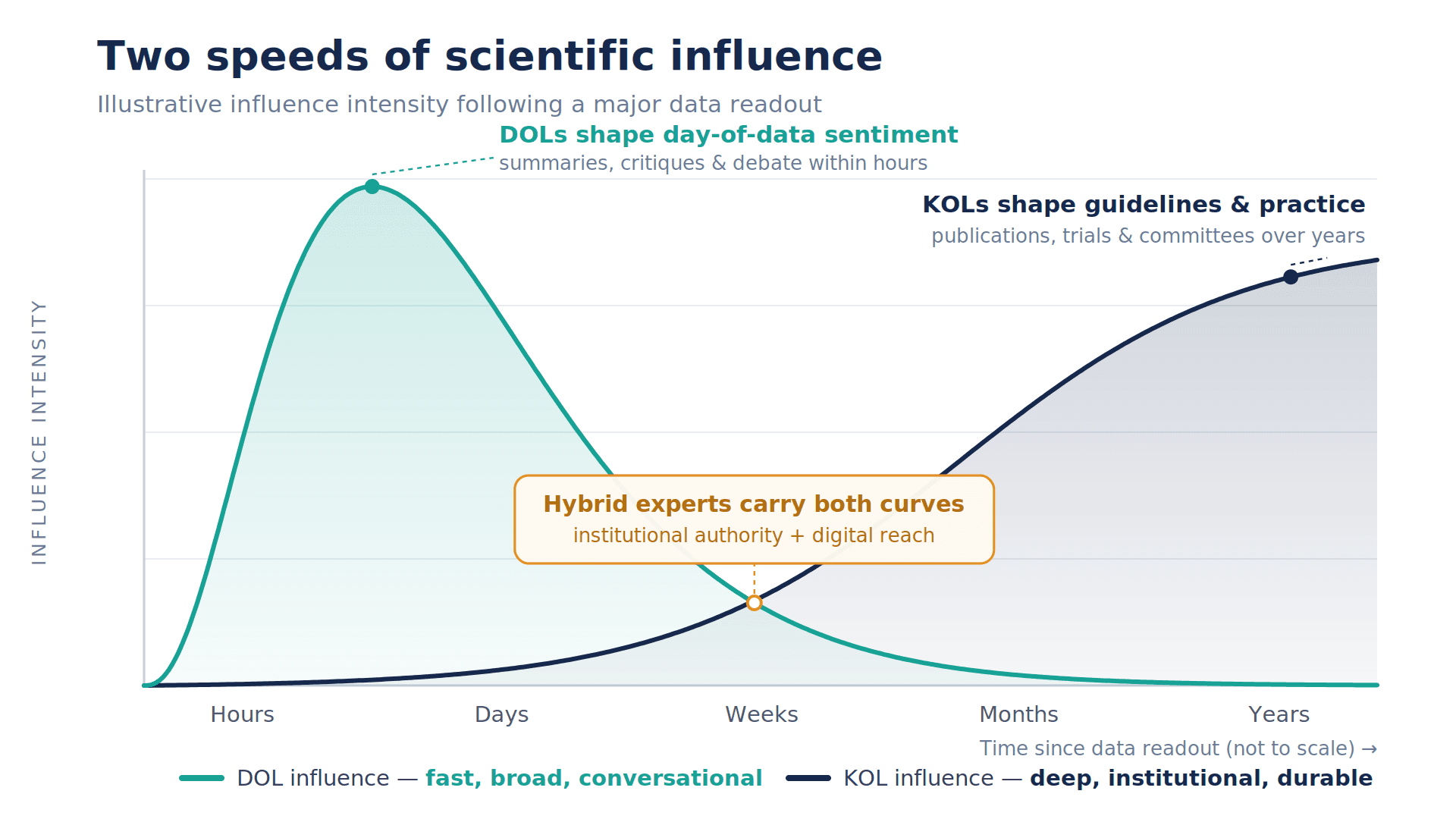
 Two speeds of scientific influence. Following a major data readout, DOL influence peaks within hours to days, while KOL influence builds over months to years through publications, trials, and guideline roles — and hybrid experts carry both curves. Illustrative, not to scale.

The overlap matters more than the distinction

Here is the part strategy teams most often get wrong: KOL and DOL are not mutually exclusive categories. They are different modes of influence, and the map of who holds each is constantly shifting. Some of the most influential voices in a therapeutic area are hybrids — guideline authors with large digital followings. Others are pure DOLs with modest publication records but enormous reach among community physicians. Some deeply influential KOLs have no digital footprint at all


Treating these as one list produces blind spots in both directions: engage only traditional KOLs and you miss day-of-data sentiment; chase follower counts and you miss the experts who will actually write the guidelines.

Medical affairs leaders increasingly describe the answer as an integrated influence map — one view that combines digital influence signals with traditional KOL identification, so field teams can prioritize experts who carry weight in both worlds [6, 7].

How life sciences teams identify DOLs

Follower counts are the least informative signal available, not least because congress-period conversation attracts noise: one analysis of ESMO congress activity found heterogeneous sources competing for attention in the same hashtags, including substantial commercial and low-quality content [2]. Rigorous DOL identification weighs signals like these instead:

  1. Relevance. Does this voice consistently discuss the disease area, mechanism, or treatment landscape in question — or is healthcare a minor part of a general feed?

  2. Engagement quality. Are clinicians and researchers responding, sharing, and debating this person's content, or is engagement primarily from the public?

  3. Network position. Is this voice connected to, cited by, or amplified by other recognized experts?

  4. Velocity and timing. Is this person shaping the conversation at key moments — data readouts, congress sessions, label changes — or commenting after consensus forms?

  5. Trajectory. Rising voices matter as much as established ones. DOL influence changes far faster than KOL standing, and today's active fellow with a sharp tweetorial habit may be tomorrow's hybrid expert.

Because these signals live across platforms and change daily, DOL identification at scale is an analytics problem, not a manual research task.

Why the distinction changes engagement strategy

KOLs and DOLs warrant different engagement models. Traditional KOL engagement runs through advisory boards, investigator relationships, congress meetings, and publication planning. DOL engagement centers on scientific exchange and education — making sure accurate, balanced information reaches the digital conversations where sentiment is actually forming — and it carries compliance considerations specific to public digital channels, a topic medical affairs bodies have flagged as a priority as DOL collaboration matures [6].

The practical implication for medical affairs teams is a single stakeholder view that tracks both modes of influence: who publishes, who presents, who posts, who gets amplified — and how each expert's beliefs about the science are evolving across all of those channels at once.

How SteepRock helps

SteepRock approaches this as one problem, not two.

OLA™ (Opinion Leader Analytics) is a proprietary advanced search engine within SteepRock's Embedded Intelligence service, spanning scientific, commercial, regulatory, and digital data domains across life sciences. OLA identifies and profiles both KOLs and DOLs in any disease area, analyzing publications, clinical trials, congress activity, claims and referral data, and social and digital media in real time — surfacing the digital voices traditional KOL lists miss alongside the institutional experts they overlap with.

SteepRock Embedded Intelligence is the unified, agentic intelligence layer that operates natively across those data domains as a single environment. It brings generative AI directly into the workflow — summarizing expert profiles, synthesizing engagement history, drafting insights, and answering natural-language questions across your stakeholder data. For KOL/DOL strategy, that means a team can ask questions no single data source can answer — “Who are the rising DOLs in our therapeutic area, and how has expert sentiment shifted since the congress readout?” — and get a synthesized, evidence-linked answer drawn from publications, congress activity, and digital conversation at once.

OLMS™ (Opinion Leader Management System) then gives medical affairs and commercial teams one compliant system of record for engaging both KOLs and DOLs — connecting external influence signals with internal engagement history, so the influence map and the engagement plan live in the same place.

See how OLA and Embedded Intelligence map KOL and DOL influence in your disease area:

The overlap matters more than the distinction

Here is the part strategy teams most often get wrong: KOL and DOL are not mutually exclusive categories. They are different modes of influence, and the map of who holds each is constantly shifting. Some of the most influential voices in a therapeutic area are hybrids — guideline authors with large digital followings. Others are pure DOLs with modest publication records but enormous reach among community physicians. Some deeply influential KOLs have no digital footprint at all


Treating these as one list produces blind spots in both directions: engage only traditional KOLs and you miss day-of-data sentiment; chase follower counts and you miss the experts who will actually write the guidelines.

Medical affairs leaders increasingly describe the answer as an integrated influence map — one view that combines digital influence signals with traditional KOL identification, so field teams can prioritize experts who carry weight in both worlds [6, 7].

How life sciences teams identify DOLs

Follower counts are the least informative signal available, not least because congress-period conversation attracts noise: one analysis of ESMO congress activity found heterogeneous sources competing for attention in the same hashtags, including substantial commercial and low-quality content [2]. Rigorous DOL identification weighs signals like these instead:

  1. Relevance. Does this voice consistently discuss the disease area, mechanism, or treatment landscape in question — or is healthcare a minor part of a general feed?

  2. Engagement quality. Are clinicians and researchers responding, sharing, and debating this person's content, or is engagement primarily from the public?

  3. Network position. Is this voice connected to, cited by, or amplified by other recognized experts?

  4. Velocity and timing. Is this person shaping the conversation at key moments — data readouts, congress sessions, label changes — or commenting after consensus forms?

  5. Trajectory. Rising voices matter as much as established ones. DOL influence changes far faster than KOL standing, and today's active fellow with a sharp tweetorial habit may be tomorrow's hybrid expert.

Because these signals live across platforms and change daily, DOL identification at scale is an analytics problem, not a manual research task.

Why the distinction changes engagement strategy

KOLs and DOLs warrant different engagement models. Traditional KOL engagement runs through advisory boards, investigator relationships, congress meetings, and publication planning. DOL engagement centers on scientific exchange and education — making sure accurate, balanced information reaches the digital conversations where sentiment is actually forming — and it carries compliance considerations specific to public digital channels, a topic medical affairs bodies have flagged as a priority as DOL collaboration matures [6].

The practical implication for medical affairs teams is a single stakeholder view that tracks both modes of influence: who publishes, who presents, who posts, who gets amplified — and how each expert's beliefs about the science are evolving across all of those channels at once.

How SteepRock helps

SteepRock approaches this as one problem, not two.

OLA™ (Opinion Leader Analytics) is a proprietary advanced search engine within SteepRock's Embedded Intelligence service, spanning scientific, commercial, regulatory, and digital data domains across life sciences. OLA identifies and profiles both KOLs and DOLs in any disease area, analyzing publications, clinical trials, congress activity, claims and referral data, and social and digital media in real time — surfacing the digital voices traditional KOL lists miss alongside the institutional experts they overlap with.

SteepRock Embedded Intelligence is the unified, agentic intelligence layer that operates natively across those data domains as a single environment. It brings generative AI directly into the workflow — summarizing expert profiles, synthesizing engagement history, drafting insights, and answering natural-language questions across your stakeholder data. For KOL/DOL strategy, that means a team can ask questions no single data source can answer — “Who are the rising DOLs in our therapeutic area, and how has expert sentiment shifted since the congress readout?” — and get a synthesized, evidence-linked answer drawn from publications, congress activity, and digital conversation at once.

OLMS™ (Opinion Leader Management System) then gives medical affairs and commercial teams one compliant system of record for engaging both KOLs and DOLs — connecting external influence signals with internal engagement history, so the influence map and the engagement plan live in the same place.

See how OLA and Embedded Intelligence map KOL and DOL influence in your disease area:

The overlap matters more than the distinction

Here is the part strategy teams most often get wrong: KOL and DOL are not mutually exclusive categories. They are different modes of influence, and the map of who holds each is constantly shifting. Some of the most influential voices in a therapeutic area are hybrids — guideline authors with large digital followings. Others are pure DOLs with modest publication records but enormous reach among community physicians. Some deeply influential KOLs have no digital footprint at all


Treating these as one list produces blind spots in both directions: engage only traditional KOLs and you miss day-of-data sentiment; chase follower counts and you miss the experts who will actually write the guidelines.

Medical affairs leaders increasingly describe the answer as an integrated influence map — one view that combines digital influence signals with traditional KOL identification, so field teams can prioritize experts who carry weight in both worlds [6, 7].

How life sciences teams identify DOLs

Follower counts are the least informative signal available, not least because congress-period conversation attracts noise: one analysis of ESMO congress activity found heterogeneous sources competing for attention in the same hashtags, including substantial commercial and low-quality content [2]. Rigorous DOL identification weighs signals like these instead:

  1. Relevance. Does this voice consistently discuss the disease area, mechanism, or treatment landscape in question — or is healthcare a minor part of a general feed?

  2. Engagement quality. Are clinicians and researchers responding, sharing, and debating this person's content, or is engagement primarily from the public?

  3. Network position. Is this voice connected to, cited by, or amplified by other recognized experts?

  4. Velocity and timing. Is this person shaping the conversation at key moments — data readouts, congress sessions, label changes — or commenting after consensus forms?

  5. Trajectory. Rising voices matter as much as established ones. DOL influence changes far faster than KOL standing, and today's active fellow with a sharp tweetorial habit may be tomorrow's hybrid expert.

Because these signals live across platforms and change daily, DOL identification at scale is an analytics problem, not a manual research task.

Why the distinction changes engagement strategy

KOLs and DOLs warrant different engagement models. Traditional KOL engagement runs through advisory boards, investigator relationships, congress meetings, and publication planning. DOL engagement centers on scientific exchange and education — making sure accurate, balanced information reaches the digital conversations where sentiment is actually forming — and it carries compliance considerations specific to public digital channels, a topic medical affairs bodies have flagged as a priority as DOL collaboration matures [6].

The practical implication for medical affairs teams is a single stakeholder view that tracks both modes of influence: who publishes, who presents, who posts, who gets amplified — and how each expert's beliefs about the science are evolving across all of those channels at once.

How SteepRock helps

SteepRock approaches this as one problem, not two.

OLA™ (Opinion Leader Analytics) is a proprietary advanced search engine within SteepRock's Embedded Intelligence service, spanning scientific, commercial, regulatory, and digital data domains across life sciences. OLA identifies and profiles both KOLs and DOLs in any disease area, analyzing publications, clinical trials, congress activity, claims and referral data, and social and digital media in real time — surfacing the digital voices traditional KOL lists miss alongside the institutional experts they overlap with.

SteepRock Embedded Intelligence is the unified, agentic intelligence layer that operates natively across those data domains as a single environment. It brings generative AI directly into the workflow — summarizing expert profiles, synthesizing engagement history, drafting insights, and answering natural-language questions across your stakeholder data. For KOL/DOL strategy, that means a team can ask questions no single data source can answer — “Who are the rising DOLs in our therapeutic area, and how has expert sentiment shifted since the congress readout?” — and get a synthesized, evidence-linked answer drawn from publications, congress activity, and digital conversation at once.

OLMS™ (Opinion Leader Management System) then gives medical affairs and commercial teams one compliant system of record for engaging both KOLs and DOLs — connecting external influence signals with internal engagement history, so the influence map and the engagement plan live in the same place.

See how OLA and Embedded Intelligence map KOL and DOL influence in your disease area:

Frequently Asked Questions

Is a DOL the same as an influencer?

Can someone be both a KOL and a DOL?

How is DOL influence measured?

Why do medical affairs teams track DOLs?

References

  1. Pemmaraju N, Thompson MA, Mesa RA, Desai T. Analysis of the Use and Impact of Twitter During American Society of Clinical Oncology Annual Meetings From 2011 to 2016: Focus on Advanced Metrics and User Trends. J Oncol Pract. 2017;13(7):e623–e631. https://pubmed.ncbi.nlm.nih.gov/28514195/

  2. European Society for Medical Oncology (ESMO) 2018 Congress Twitter analysis: from ethics to results through the understanding of communication and interaction flows. ESMO Open. 2020. https://pmc.ncbi.nlm.nih.gov/articles/PMC7046424/ (verify author list before publishing)

  3. Komodo Health. Identifying Key Opinion Leaders in an Online World. https://www.komodohealth.com/perspectives/identifying-key-opinion-leaders-in-an-online-world/ (secondary source for the MAPS 2018 definition — confirm against MAPS primary material)

  4. Green A, Wu S, Di Pasquale A, Pang T. The Role of Digital Opinion Leaders in Dengue Prevention Through Health Promotion and Public Health Collaboration: Qualitative Semistructured Interview Study. J Med Internet Res. 2025;27:e70997. https://www.jmir.org/2025/1/e70997

  5. Creation Healthcare. Analysis of 13,789 posts by 354 breast cancer oncologists, Jan–Dec 2024. Reported in Oncology News Today, March 2025. https://oncologynewstoday.co.uk/breast-cancer-oncologists-use-social-media-to-engage-with-latest-research-network-with-peers-and-educate-wider-public-study-finds/

  6. Medical Affairs Professional Society. Digital Opinion Leaders and HCP Influence Mapping — 2025 MAPS Roundtable. https://medicalaffairs.org/dol-hcp-influence/

  7. Medical Affairs Specialist. Harnessing Digital Opinion Leaders and HCP Influence Mapping to Transform Medical Affairs Strategies. 2025. https://medicalaffairsspecialist.org/blog/harnessing-digital-opinion-leaders-and-hcp-influence-mapping-to-transform-medical-affairs-strategies

Phone

Want to speak with us directly?

Enter your phone number and we will give you a call

We can help you achieve your goals

For more than 20 years, SteepRock has served as a recognized thought leader and best in class strategic partner across the pharmaceutical, biotech, medical device, animal health, and nutrition industry segments. Your success is our success. We deliver technology, information and analytics to help support the most critical business decisions shaping the healthcare landscape and support the entirety of your business with AI making you and your team more efficient and responsive.

Copyright © 2025 SteepRock Inc. SteepRock is a registered trademark of SteepRock, Inc. All rights reserved.

Phone

Want to speak with us directly?

Enter your phone number and we will give you a call

We can help you achieve your goals

For more than 20 years, SteepRock has served as a recognized thought leader and best in class strategic partner across the pharmaceutical, biotech, medical device, animal health, and nutrition industry segments. Your success is our success. We deliver technology, information and analytics to help support the most critical business decisions shaping the healthcare landscape and support the entirety of your business with AI making you and your team more efficient and responsive.

Copyright © 2025 SteepRock Inc. SteepRock is a registered trademark of SteepRock, Inc. All rights reserved.

Phone

Want to speak with us directly?

Enter your phone number and we will give you a call

We can help you achieve your goals

For more than 20 years, SteepRock has served as a recognized thought leader and best in class strategic partner across the pharmaceutical, biotech, medical device, animal health, and nutrition industry segments. Your success is our success. We deliver technology, information and analytics to help support the most critical business decisions shaping the healthcare landscape and support the entirety of your business with AI making you and your team more efficient and responsive.

Copyright © 2025 SteepRock Inc. SteepRock is a registered trademark of SteepRock, Inc. All rights reserved.